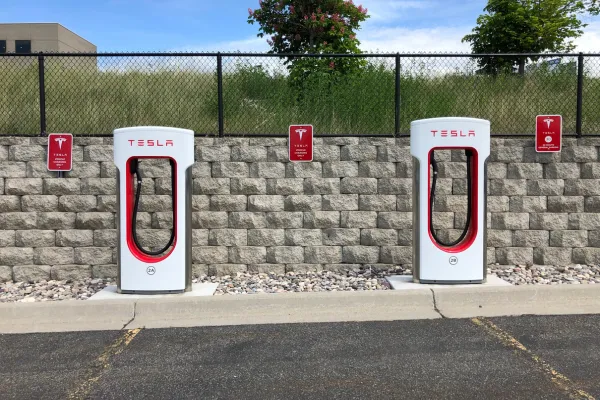
Charging a Tesla
Charging a Tesla was a new experience. It looks like the chargers that are ubiquitous now, in even the smaller cities, are a money maker for those who own them---such as Tesla. Thus, I purchased a home charging station. I am in the Wright-Hennepin coverage area, and they offer a $500 rebate on the purchase of this unit. Good deal! That was close to what I paid.
While awaiting the process to get it up and running, my options for charging started at these public chargers. Since everything about the Tesla runs off your phone, you pull up a screen that shows where the various charging stations are around where you are at. You indicate the one you want to use and push the button on your car’s screen and---voila—it takes you there and backs up to the charger.
I have placed my charge card in the Tesla system on my phone, so it automatically links to the charger. No steps to take---just plug in and wait. This step takes time. You can exit in 15 minutes, but you will have only charged the battery a modest amount. I find that 25 minutes will give me another 100-130 or so miles---sufficient for driving around the metro or near home. $0.42/kilowatt! I really had to read that twice. I spent $22, which was reasonable vs. the gas pumps, but still, in our home we pay in the range of $0.12/kilowatt. I thought that was a steep mark-up for the convenience of having one available on the road. I hear stories of folks paying $0.60/kilowatt in some cities.
The next step is obvious to get the home charger up and running. When that is operational, the rates for charging drop dramatically. If I set it to charge between 10PM and 5AM, which I certainly can, the rate drops to $0.08/kilowatt. Of course, in an emergency if I need to charge in the evening, the rate suddenly climbs up to $0.32/kilowatt. As a fully retired and laid-back individual, I plan on meeting the challenge of charging while I sleep. I will lay there thinking about all the money I am saving.
While waiting for the home charger to be installed, Tesla provides options in a kit in the trunk. I found one that hooks up to the standard 110-volt house outlet. That is the current way I am charging the car. However, it adds power at the rate of only 5 miles/hour! Not a problem for an old retired guy. I just let it run 36 hours until it was fully charged. That is a lot cheaper than going to the charging stations.
It is interesting to see the screen on the car during this charging process. It shows a picture of the bank of batteries mounted under the car. They are mounted in 8 sections pictured showing them sideways on the car. Depicted on the screen is the power flowing into one of these sections and the next one or two clear and needing charging. Fascinating I thought.
Speaking of charging, they have a built-in system for charging your phone. You simply place it on the center console in the front seat and it starts charging. They have built in a section where it lays where you can still see the screen if a message comes through. My previous Lincoln from 2020 had the phone connected such that messages could be received and sent via the screen. Tesla has no such ability. When I asked “Grok” about that she said it was the #1 ask for Tesla to take care of and install. For all the technology in the car, how did they miss that one? Other older vehicles seem to do that easily.
If I come to visit you, be watchful. I could very well bring an extension cord and plug in my car to one of your outside outlets. I want to do that serendipitously rather than ask—it is more fun that way………With some history of charging, I will in the near future be able to calculate the cost per driving mile compared to the cost of internal combustion engines.